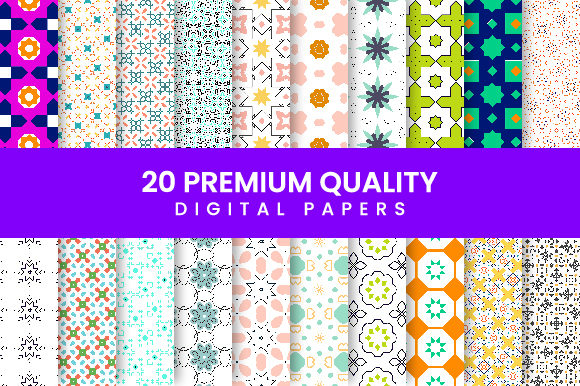
Creative Geometric Pattern Design: Where Precision Meets Expression
At first glance, Creative Geometric Pattern Design might sound like a niche term reserved for architects or textile engineers. But in reality, it’s a quietly powerful visual language—one that shapes how we experience spaces, products, interfaces, and even brand identities. Unlike generic repeats or algorithmic tiling, Creative Geometric Pattern Design blends mathematical structure with intentional artistry: symmetry meets surprise, repetition carries rhythm, and geometry becomes storytelling.
What Exactly Is Creative Geometric Pattern Design?
Creative Geometric Pattern Design is the thoughtful, human-led process of constructing visual motifs using points, lines, angles, polygons, and spatial relationships—then arranging them with purpose. It’s not just about drawing triangles or tessellating hexagons. It’s about why those shapes interact the way they do: how scale shifts perception, how color contrast guides the eye, how negative space breathes life into density.
This practice sits at the intersection of mathematics, craft, and cultural context. A Moroccan zellige tilework pattern shares foundational logic with a modern app loading animation—but each expresses distinct values: heritage versus immediacy, permanence versus fluidity. That’s the hallmark of true Creative Geometric Pattern Design: geometry as a vessel—not just decoration.
Core Characteristics That Set It Apart
- Intentional asymmetry: Even in balanced layouts, subtle variations prevent visual fatigue—like shifting the weight of a diamond grid by 2% to evoke motion.
- Layered hierarchy: Patterns often operate across scales—micro-texture in fabric weave, mid-scale motif on packaging, macro-arrangement on a building façade.
- Context-responsive form: A pattern designed for a children’s book cover uses softer angles and playful spacing; one for a financial dashboard prioritizes clarity, alignment, and scannability.
- Human-crafted rhythm: Algorithms can replicate repetition—but only a designer decides when to break it meaningfully (e.g., inserting a single rotated octagon into an otherwise uniform square lattice).
Who Benefits—and Where Does It Show Up?
Creative Geometric Pattern Design isn’t confined to studios or print shops. Its influence flows across everyday touchpoints:
- Interior designers use it to define spatial flow—think floor tiles that subtly direct movement toward a seating area, or wall panels that modulate acoustics while anchoring aesthetic tone.
- Product developers embed it into material surfaces: silicone grips with hexagonal dimples for ergonomic traction, or biodegradable packaging with laser-etched fractal folds that strengthen structure without added layers.
- Digital creators apply it beyond backgrounds—loading states, data visualization icons, or scroll-triggered transitions where shape morphs convey progress or status.
- Educators and therapists leverage its predictability and variation to support focus and cognitive processing—pattern-based worksheets for neurodiverse learners, or calming wall murals in sensory rooms.
- Small business owners find high impact with low overhead: a custom geometric logo lockup that scales from social avatars to storefront signage, or branded packaging that stands out on crowded shelves through intelligent negative space—not louder colors.
Real-World Applications You’ve Likely Encountered
You may not have named it—but you’ve felt its effect.
- A café’s ceramic mug features interlocking chevrons that align perfectly when stacked—a small detail that signals care in manufacturing and invites tactile engagement.
- An online meditation app uses a slowly rotating triangular mandala behind session timers. Its geometry doesn’t distract—it grounds attention without demanding interpretation.
- A sustainable fashion label prints fabric using parametric geometry: each garment’s pattern shifts slightly based on cut dimensions, minimizing waste while ensuring no two pieces are identical—a fusion of ethics and uniqueness.
- A public library’s wayfinding system replaces text-heavy signs with color-coded geometric glyphs (a trapezoid for “study rooms,” a nested circle for “digital lab”). Patrons navigate faster—and children learn spatial symbols before reading fluency.
Strengths Worth Leaning Into
Creative Geometric Pattern Design offers rare versatility:
- Scalability without loss: Vector-based geometry retains fidelity whether printed on a business card or projected across a 30-foot wall.
- Cross-cultural resonance: While motifs carry meaning, fundamental shapes—circles, grids, spirals—trigger universal perceptual responses tied to cognition and environment.
- Adaptability to medium: The same core pattern system can inform embroidery stitch counts, CNC router paths, CSS grid layouts, or AR surface mapping—bridging physical and digital production.
- Brand cohesion anchor: When applied consistently, geometric patterns create subconscious recognition—more durable than fonts or palettes alone, because they operate at a structural level.
Practical Considerations Before You Begin
Not every project needs—or benefits from—Creative Geometric Pattern Design. Honest evaluation helps avoid missteps:
- Misalignment with audience expectations: A law firm’s website using jagged, high-contrast polygons may unintentionally signal aggression over authority. Simpler, grounded geometries (balanced rectangles, restrained diagonals) often serve trust-based industries better.
- Production complexity: A hand-drawn geometric repeat may translate beautifully to screen but require costly re-engineering for woven textiles. Always test early in your intended medium.
- Over-design risk: Too many layers of geometry—nested shapes, competing rotations, micro-variations—can overwhelm rather than clarify. Ask: “Does this element support the user’s goal—or compete with it?”
- Accessibility oversight: High-contrast patterns improve visibility for many—but dense, vibrating combinations (e.g., thin red-on-blue stripes) can trigger discomfort or seizures. Tools like the WCAG contrast checker and photosensitivity simulators are essential companions.
Evaluating Suitability for Your Project
Ask these questions—not to eliminate Creative Geometric Pattern Design, but to refine its role:
- What action should the viewer take next? (e.g., “Find the nearest exit” → clear directional geometry; “Browse collections” → gentle, branching forms)
- Where will this live? (A mobile interface demands larger touch targets and reduced visual noise; a mural invites intricate layering.)
- What emotion or value must it reinforce? (Stability? Use horizontal emphasis and right angles. Innovation? Introduce controlled irregularity—like a single curved edge in a polygonal field.)
- Do existing assets constrain or inspire? (A client’s logo contains a 45° diamond? Build outward from that angle—don’t fight it.)
Remember: Creative Geometric Pattern Design isn’t about filling space. It’s about shaping how people move through it, understand it, and remember it. Whether you’re sketching on paper, coding in Figma, or specifying materials for fabrication—the strongest outcomes begin with asking not “What shape looks cool?” but “What shape serves?”
When geometry carries intention—not just aesthetics—it stops being background. It becomes architecture for attention.